ZiS-5 (3-K)
Aside from the ZiS-5 we know and love, there was another project with this designation, which started in early 1941. The gun was based on the 3-K model 1939 76 mm AA gun, and was noticeably longer than the ZiS-5 that ended up on the KV in late 1941.
Showing posts with label AFV. Show all posts
Showing posts with label AFV. Show all posts
Tuesday, March 14, 2017
ZiS-5 (3-K)

Monday, July 18, 2016
Unique Soviet T-34 tank recovered from river in south Russia

The solely survived Soviet T-34-76 tank produced at the Stalingrad Tractor Factory has been retrieved from the Don River in south Russia, a TASS correspondent reports from the scene.
The operation to recover the WWII Soviet tank was carried out near the village of Ukrainskaya Builovka in the Voronezh Region by specialists of Patriot Park in the Moscow Region, servicemen of Russia’s Western Military District and divers.
The tank was successfully retrieved by a BREM-1 repair and evacuation vehicle based on a T-72 tank from the 7-meter depth. The armored vehicle that had stayed at the river bottom for more than half a century endured the operation well.
TASS reported earlier with reference to Head of the Patriot Park Department for Exhibits’ Search, Repair and Restoration Anatoly Kalemberg that all T-34 tanks produced at the Stalingrad Factory had been destroyed in battles during the first years of the Soviet Union’s Great Patriotic War against Nazi Germany in WWII.
Two versions exist about how the T-34-76 tank got into the river bed. The first version has been offered by local residents who say that the Soviet troops sank the tank during their retreat so that it would not get into the enemy’s hands.
However, as Kalemberg said, the tank’s armament was not removed, which speaks against this version.
According to the second version, the tank was moving along a pontoon bridge when it fell into the river. This version appears to hold true as the sunken pontoons, transport vehicles and small-size vessels stayed close to the tank at the river bed. As Kalemberg said, the tank was most likely lost in the summer of 1942.
Patriot Park specialists said earlier the tank weighs about 30 tons.
The unique T-34 tank recovered from the river has remained in a very good condition and can run again, Kalemberg said.
"If it is restored externally, this won’t be difficult and won’t take much time as it has remained in a very good condition. If we start restoring it to its running condition, this will take more time," he said, speaking about the time limits of the tank’s restoration.
"I hope we’ll restore it to the running condition," Kalemberg said.
According to preliminary data, there are neither munitions and other dangerous items nor crew remains inside the tank.
Source: Tass.com
Wednesday, August 12, 2015
Cold War Weaponry - AFVs


It is difficult today to remember that at the height of the
Cold War the possibility of Communist hordes pouring across Central Europe was
a very real threat. For four decades Europe stood on the brink of the Third
World War, thanks to the heavily-armed standoff between the North Atlantic
Treaty Organisation (NATO) and the Warsaw Pact. Thankfully it was the war that
never was. The Cold War became a historical footnote, sandwiched between the
Second World War and the conflicts of the early twenty-first century. It is one
of those intriguing ‘what ifs?’ of history.
Washington never allowed its NATO allies to forget the
extent of the Soviet threat. Annually throughout the 1980s the US Department of
Defense published its Soviet Military Power, which catalogued Moscow’s
strategic aspirations and its latest military developments. Anyone reading it
was left feeling that war was imminent and woe betide NATO if it was not ready.
By the mid-1980s the Cold War was at its height, with a
conventional and nuclear standoff across Europe divided by the Iron Curtain. As
part of its forward defence Moscow deployed armies in Eastern Europe with the
Group of Soviet Forces in Germany, the Northern Group in Poland, the Southern
Group in Hungary and the Central Group in Czechoslovakia. This not only guarded
against NATO but also ensured none of the other Warsaw Pact members could
defect. These forces were used to stop a repeat of the anti-Soviet uprising in
East Germany of 1953, the Hungarian Revolt of 1956 and the Prague Spring of
1968. The following year the Soviet armed forces were involved in a Sino-Soviet
border conflict and in 1979 became embroiled in a ten-year struggle in
Afghanistan.
After the Second World War with tensions mounting between
the Western allies and the Soviets, Berlin remained divided between the
American, British and French sectors that made up West Berlin and the Soviet
sector that occupied the east. This resulted in the Soviet blockade of West
Berlin from June 1948 to May 1949. In response the Allies organised the Berlin
airlift and war in Europe was only narrowly avoided. However, the Cold War went
hot around the world, most notably in 1950 with the conflict in Korea.
The Warsaw Pact of 1955 brought together eight communist
states in Central and Eastern Europe. Moscow argued the pact was a defensive
move in light of West Germany being allowed into NATO. The reality was that it
bound Eastern Europe’s militaries to the Soviet armed forces. The Soviet Union
was divided into military districts, with the key ones being the Baltic,
Leningrad, Moscow and Kiev. By this stage the Soviet ground forces consisted of
over 200 divisions, down from 500 at the end of the Second World War.
Not only did the Soviets have the numbers, they also had a
vast array of weaponry. If there was one thing the Soviet Union was
particularly good at it was building tanks. Since the mid-1950s Soviet-designed
tanks dominated every single conflict right up until the 1991 Gulf War. Two
designs in particular proved to be Moscow’s most reliable workhorses – these
are the T-54 and T-62 main battle tanks (MBTs). They are direct descendants of
the Soviet Union’s war-winning T-34 and Joseph Stalin tanks. They drew on the
key characteristics of being easy to mass-produce, extremely robust and easy to
use. As a result they were ideal for the less-well educated armies of the
developing world. Having been inside a Czech-built T-54 I can testify that they
are certainly no-frills tanks. The finish is not good and there are no creature
comforts – clearly a legacy from the Spartan conditions inside the T-34.
Nonetheless, they did the job that was required of them.
The scale of Soviet armour manufacturing at its height was
immense. The tank plant at Nizhniy Tagil was supported by at least three other
key tank factories at Kharkov, Omsk and Chelyabinsk, while other armoured
fighting vehicles (AFVs) were manufactured at seven different sites. In the
1980s the Soviets were producing approximately 9,000 tanks, self-propelled guns
and armoured personnel carriers/infantry fighting vehicles (APCs/IFVs) a year.
The Soviet Union’s East European Warsaw Pact allies managed another 2,500.
Moscow sent almost 8,000 tanks and self-propelled guns and
over 14,000 APCs/IFVs to the developing world during that decade alone. In
effect they exported two and a half years’ worth of production. The Soviets’
ability to manufacture such vast numbers of tanks meant that on at least two
occasions they were able to save Arab armies from complete disaster at the
hands of the Israelis.
By the 1980s Moscow had a staggering 52,600 tanks and 59,000 APCs in its active inventory, with another 10,000 tanks and APCs in storage. After the Warsaw Pact force-reduction talks in Eastern Europe, in 1990 Moscow agreed to withdraw 10,000 tanks and destroy half of these without batting an eyelid. Warsaw Pact members also agreed to cut tank numbers by almost 3,000. At the same time the Soviets began to field newer tanks such as the T-64B, T-72M1 and the T-80, while retiring older-model T-54/55s and T-62s. They also improved their IFV forces by fielding large numbers of the tracked BMP-2 as well as improving the earlier BMP-1. The net result was a huge surplus of wheeled AFVs available to the developing world.
The British Army of the Rhine (BAOR) was once part of the
bulwark that helped protect Western Europe from the threat posed by the Soviet
groups of forces stationed across Eastern Europe and their Warsaw Pact allies.
At the height of the Cold War BAOR, serving with NATO’s northern army group,
represented the largest concentration of ground forces in the British Army. It
consisted of the isolated Berlin Independent Brigade and the 1st British Corps
in West Germany. HQ BAOR was based at Rheindahlen while HQ 1 (BR) Corps was at
Bielefeld, commanding three divisions.
The fate of the American, British and French garrisons in
West Berlin had the Cold War gone hot would have been certain. It is likely
that the Warsaw Pact would have first cut them off and then overwhelmed them.
But this never came to pass, however; West Germany and East Germany along with
the two halves of Berlin were reunited on 3 October 1990. The following year
the Soviet Union collapsed and the Cold War came to an end.
While the Cold War resulted in an armed standoff either side
of the Iron Curtain, Moscow actively supported the spread of Communism,
elsewhere most notably in Korea and Vietnam. Tanks with one previous owner, no
strings attached (except when that previous owner happened to be the Soviet
Union, there were always strings attached). The fact that the tank was ancient,
would not meet your operational requirements and leave you heavily indebted to
Moscow did little to deter many developing countries desperate for huge
quantities of weapons. From the Horn of Africa to Central America, the Soviet
T-55 and T-62 MBTs became as ubiquitous as the Kalashnikov AK-47 assault rifle.
Although the two Superpowers were cautious about coming into
direct confrontation, this did not prevent indirect meddling elsewhere in the
world. On the periphery, the Cold War became very hot and on a number of
occasions almost sparked war in Europe. Time after time Moscow was able to make
good its allies’ massive losses. The Soviets conducted a substantial re-supply
of Syria in 1982–3 following their military losses in Lebanon. Major re-supply
also took place in 1977–9 in support of Ethiopia in its clash with Somalia and
during the Arab-Israeli Wars of 1967 and 1973. Prior to that they conducted
airlift operations in 1967–8 in support of a republican faction in North Yemen.
At the height of the Cold War the Soviet Union exported
billions of dollars’ worth of arms to numerous developing countries.
Intelligence analysts watched with a mixture of alarm and awe as cargo ship
after cargo ship sailed from Nikolayev in Ukraine stacked to the gunnels to
ports such as Assab in Ethiopia, Luanda in Angola, Tartus in Syria and Tripoli
in Libya. Much of this equipment came from strategic reserves and was very old
or had been superseded by newer models, as in the case of the T-55 and T-62
MBTs, which were all but obsolete by then. Soviet armoured vehicle exports also
included the 4x4 wheeled BTR-60 APC and the tracked BMP-1 IFV.
In many cases Soviet weapon shipments were funded through
generous loans, barter-deals or simply gifted, and Moscow’s arms industries
rarely saw a penny in return. The net result was that during the Cold War
Moscow fuelled a series of long-running regional conflicts that lasted for
decades. Ultimately the West was to spend the Soviet Union into oblivion, but
the legacy of the Cold War was one of global misery.
Tuesday, March 17, 2015
IS-2 Tank

Redesign of the IS-1 in order to work out problems but
also to reduce the weight, improve the armor, provide an improved shape, and
simplify production.
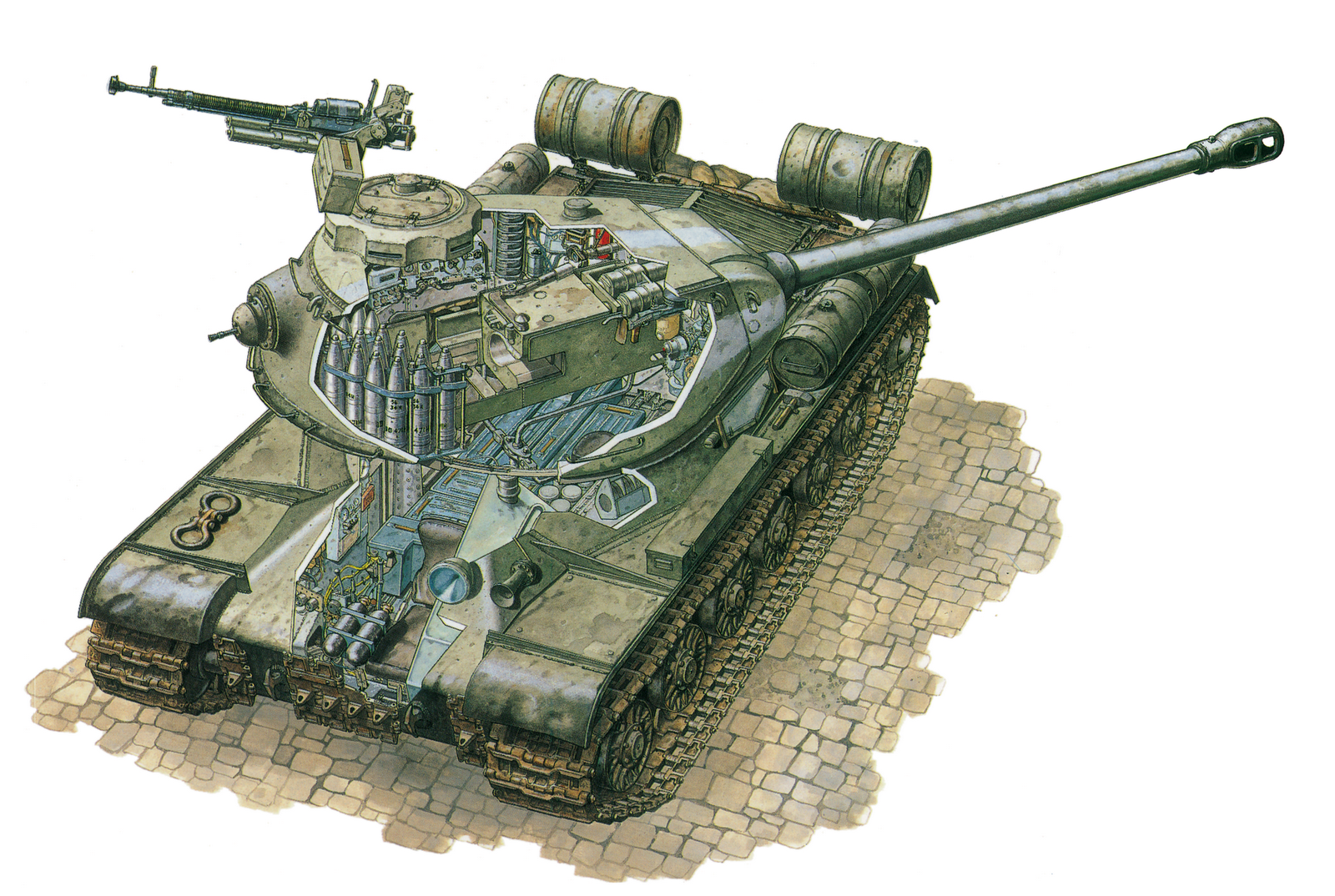
Well-armed and well-armored, its chief shortcoming was
the slow rate of fire of the main gun, the consequence of separate projectiles
and cartridges.


Early in the autumn of 1943, the Soviets
were completing the first of three prototypes of their new IS-1 (IS-85) heavy
tank using design experience gained from their previous KV heavy tank projects.
These new IS (Iosef Stalin) prototypes were systematically demonstrated before
the special commission from the Main Defense Commissariat and with the
completion of general factory trials the IS design was approved for production.
Although the first production vehicles mounted the 85mm gun also seen on the
T-34/85 medium tank, these initial IS-1 tanks were shortly converted to carry
the 122mm M1943 D-25 gun before they were provided to the tank troops. The new
IS-2 tank weighed little more than its predecessor KV tank, but it had thicker
and better-shaped armor that provided vastly improved protection. The overall
weight was kept low by using a more compact hull and component design, as we
shall see later. Once the 122mm gun was installed and series production
continued, the new "Tiger Killer" was officially named the IS-2 Heavy
Tank, although its weight and armor characteristics closely coincided with the
German Panther medium tank. By the end of 1943, the Kirov Factory had produced
a total of 102 IS-2 heavy tanks and they were used for the first time in
February of 1944 at Korsun Shevkenskovsky. Although there were a number of
external improvements to the IS-2 during its production and field use, there
were relatively few internal changes made over the years.
The IS-2 hull was designed after ample
combat experience with the KV tanks, and you can see that the hull actually
overhangs the tracks. It is an interesting hull design in that the bow casting
is welded directly to a circular casting for the base of the turret. Additional
rolled armor plates are then added to form the rest of the hull sides, ending
at a sloping rear plate that covers the engine and transmission. Both heavy
armor castings and rolled plate are utilized in the hull, and the castings in
the bow provide around 122mm (4.7in) of frontal armor. This initial bow design
was based on the earlier KV-13 tank layout.
Although the first IS-2 vehicles used this
curved and gently sloping front bow casting, it was later replaced in 1944 with
either a new casting or a welded plate nose, both of which had a straight
60-degree slope from glacis to the top of the hull. The Uralsky Factory of
Heavy Machinery (UZTM) plant made the welded noses, while factory #200 made the
cast types. The IS-2 was one of the first production Soviet tanks to remove the
traditional second driver/hull machine gunner from the bow of the tank,
providing additional space for fuel tanks. In place of a ball mounted MG on the
front plate, a DT machine gun was mounted on the right side of the hull behind
the driver and up near the turret ring. It was fired via a remote control
firing cable from the driver's position.
The new tank design illustrates the
Soviet's mid-war combat strategy reorientation from using tanks for infantry
assault to tank hunting and killing machines. As a result, the second driver in
the hull was deemed unnecessary and the crew was reduced from the traditional
five soldiers to only four, the driver then placed in a central position in the
bow. The commander is located inside the turret at the left rear, the gunner is
to the left of the main gun, and the loader is to the right. Both the gunner
and loader are provided with over-head periscopes and the commander has a
non-rotating turret cupola incorporating vision blocks that provided a
360-degree field of view. He also has a rotating periscope in his cupola hatch.
A round roof hatch that is flush with the turret roof is provided for the
loader on his side of the turret.
Initially, the 122mm L/43 gun mounted in
the cast turret retained its original interrupted screw breech, showing its
ancestry from the already proven D-19 field gun. But the screw field gun breech
was replaced (by early 1944) with a horizontally sliding block, semi-automatic
type, and of course the recoil cylinders and elevating mechanisms were altered
from the field gun to fit into a turret. Because the 122mm ammunition rounds
were so huge, they were provided in separate pieces, a projectile and a charge
cartridge, but even so only 48 complete rounds could be stored inside the tank.
Although a number of ready rounds were strapped into easily reached racks in
the turret, most of the ammo was stored in sheet metal boxes down on the hull
floor and, as we have seen in the T-34/76, these boxes were often covered with rubber
floor mats. There was no turret basket in the IS-2; the turret crew seats were
either suspended from the turret and rotated along with it (commander's) or the
seats were supported on tubes that rose from the center of the floor and also
rotated with the turret (gunner and loader).
By the time the IS tanks were being
manufactured, the Soviets had plenty of technical experience with casting large
pieces of armor, and the IS-2 turret became one of the biggest castings they
manufactured during the war. Although Western writers have tended to criticize
the coarse standard of Soviet armor finish, the urgency of tank manufacture in
1943 did not warrant lavishing extra time and energy on unnecessary
refinements. Over the course of its production, the turret was gradually
changed. The early IS-2 tanks that were manufactured in 1943 were originally
designed to have installed a D-5T 85mm gun in their turrets, and they had a
narrow opening for the telescopic sight just to the left of the gun. When the
122mm D-25T gun was placed inside these same turrets, it was very hard for the
gunner to use his telescopic sight, as it was so close to the gun. So, in
mid-1944 a new turret with a larger sight opening that was also shifted
slightly to the left was produced. Also at this time the thickness of the
turret's mantlet was increased, along with the lower hull sides. The new turret
also moved the commander's cupola slightly to the left and the gunner's PT4-17
periscopic sight in the turret roof was changed over to a Mk.4 type. About this
time a Model 1938 12.7mm DShK anti-aircraft machine gun was installed outside
on the commander's cupola to provide some protection from strafing German
aircraft.
Production dates: April 1944–June 1945
Number produced: 2,250
Manufacturer: Factory No. 100,
Kirovskiy Works (Chelyabinsk)
Crew: 4
Armament: 122mm gun D-25T; 1 x 12.7mm DShK
machine gun; 2 x 7.62mm DT machine guns
Weight: 101,184 lbs.
Length: 32’
Width: 10’2”
Height: 8’10”
Armor: maximum 129mm; minimum 60mm
Ammunition storage and type: 28 x 122mm;
945 x 12.7mm; 2,330 x 7.62mm
Power plant: V-2-IS (V2-K) V-12 600-hp
diesel engine
Maximum speed: 23 mph
Range: 100 miles
Fording depth: 4’3”
Vertical obstacle: 3’2”
Trench crossing: 8’2”
T-60 AND T-70 IN ACTION


The performance of the T-60 and T-70 light tanks in combat
was far from satisfactory because of a combination of inferior armour and lack
of firepower. A noted critic of these two tank types was Major-General M.E.
Katukov. In a meeting with Stalin in autumn 1942, Katukov told him that his
crews did not like the T-60:
It has only a 20mm
[0.78in] gun. In serious combat with armoured forces it just does not have it
... To attack in mud or snow is a deadly affair. In the battles around Moscow,
we continually had to drag them in tow.
He was more cautious, however, about the new T-70, but
nonetheless noted, somewhat sceptically, 'It has not shown us anything special.'
Katukov was right about the crews' intense dislike of the
T-60: they nicknamed them BM-2, meaning Bratskaya Mogila na Dovoikh; quite
literally, 'a brother's grave for two', referring to the tank's vulnerability
to German antitank fire. On the other hand, they were better than nothing
during the dark days of 1941 and 1942, and as commander of I Tank Corps during
fierce fighting earlier in 1942, Katukov was forced to acknowledge the debt he
owed them:
And now, in this
fateful hour, when the Germans had almost defeated us, those 'ridiculous' tanks
saved our positions. It was lucky that the rye in the area was over a metre
high, as the T60s were almost hidden by it. Using this rye field, both of our
T-60 tanks were able to infiltrate to the rear of the German infantry and then
open fire. After several minutes of intensive fire, the German attack was
halted.
The T-70's most dramatic engagements came in July 1943 at
the Battle of Kursk, the climax of the German summer offensive. On 12 July, the
Soviet Fifth Guards Tank Army and German II SS Panzer and III Panzer Corps
clashed on a 32km (20 mile) front before the village of Prokhorovka. In all,
during the heavy fighting, 429 German tanks and 870 Soviet· tanks were engaged,
and this number included 261 T-70 light tanks. Although Soviet tank losses were
significantly greater than those of their opponents (perhaps even as much as
three times as high), the German advance was contained and the battle
subsequently swung in favour of the Soviets. At the height of the battle on 12
July, the Red Army's 31 st Tank Brigade succeeded in penetrating the rear
elements of the 1st SS Leibstandarte Adolf Hitler Panzergrenadier Division. The
1st SS Divisional history recorded the sheer ferocity of the tank action:
the remaining three
Panzers ... could fire at the Russians from a distance of 10 to 30 metres
[30-90ft] and make every shell a direct hit because the Russians could not see
through the dust and smoke that there were German tanks rolling along with them
in the same direction. There were already 19 Russian tanks standing burning on
the battlefield when the Abteilung [2nd Panzer Regiment] opened fire for the
first time ... destroying 62 T-70s and T-34s in a three hour long battle that
could almost be termed hand-to-hand combat.
Soviet losses were inflated by the Germans, but it seems
clear that a large number ofT-70s were lost. For the rest of the war, the T-60
and T-70 were gradually removed from combat roles and used for convoy duties,
reconnaissance, training and defending headquarters.
Subscribe to:
Posts (Atom)